Showing posts with label #peru. Show all posts

Sunday, November 10, 2013

Living in Peru's Amazon Rainforest

It's always been my dream to visit the Amazon rainforest - so I loved (almost) every minute of our visit!  It was like God was having fun showing off his creation just for us!  If this is a taste of what we'll see in the New Earth someday, I can only imagine.....


We stayed at one of those wonderful lodges where you room is open on one side to the jungle.  The plus of this was that you heard all those wonderful jungle noises, and got to see cute littel animals scurrying all around.  The downside is you had to sleep under a net.  When you open your eyes, this is NOT what you want to see!

And when you go to the bathroom, this is NOT what you want to find!  This little friend was caught in our neighbor's bathroom, as he was trying to climb the wall into our room...


But aside from that, it was WONDERFUL!  Here are a few pictures of things we enjoyed seeing:

A whole flock of Macaw's - we watched them come into the trees a couple at a time, then after something started them, ~25 took off together.  Beautiful!

We also saw toucans and parakeets in the wild (but couldn't work fast enough to get pics).

This is a HUGE tree that is totally hollow inside - you can walk into it.   What happens is this tree (Tree A) grows next to another tree (Tree B) - it starts engulfing Tree B and eventually totally covers it up. tree B then dies, leaving a big hollow inside tree A.  Pics are outside and inside Tree A.  Apologies for the duplicate pics - Blogger and my iPhone are not cooperating - so now you get to see us twice :-)


Monkeys - lots to see, but hard to get pics!  


The things hanging from the palm tree are the nests of the Weaver bird....


Lots of Brazil nuts everywhere!!!  We had Brazil nuts for snacks, Brazil nut crusted chicken Brazil nut crusted everything!  They grow in these coconut looking things.  The one on the left was opened by an animal.  The one on the right was opened by machete....


Well......I had never seen one of these things growing up from the forest floor before.  They are air holes for cicadas buried under the ground.  So when it rains in the rainforest, even if it pours, the cicadas are able to get air.  Hooray for the cicadas......


So they can live to get into your room at night and clatter around the light fixtures and everything else.  In the rainforest there are no seasons oryears when you get a lot of cicadas.  There are just a lot of cicadas.....all. the. time.  LOTS.


I could have gone the rest of my life withiut seeing a tarantula nest, but since we found one, I thought I'd share it with you.  Our fearless guide thought it would be a fun idea to poke it with a stick to see if he could coax the tarantula into coming out.  YIKES.  Fortunately, the tarantula must have been sleeping off a big meal - she was not interested in coming out.  Whew!  FYI - the tarantula is above the stick at the top of the area covered by white.  Just look for the dark shadowing.....


For those who have seen fabrics made from Kapok, this is a Kapok tree.  It is HUGE.

And this is the opened pod of the Kapok tree, where they get the Kapok from....
 

Termites in a tree - yum...  If you look at the dark area going up the tree to the big termite nest....that area is a big tunnel the termites have built onto the tree and leading into the nest.


Well, I bet you typhought bats slept in the dark.  Not these bats!  The bumps on the tree below are cute little bats - they are sleeping on a tree at the edge of the lake, where they are positioned to snag the bugs that fly around the lake.

Oh, and did I mention the paranas?  Yep, the lake was FULL of them.  You could throw a little piece of bread in the lake, and all of a sudden the water erupted in paranas tearing into the bread.  Great incentive to stay in the boat!

This little guy is a Carybara, the largest rodent in the world.  He looked to be a couple feet long - and generally always has a bird perched on him to eat the bugs on him.


Well, so much for the brief overview of the Amazon.  You could stay there for a long time and still just scratch the surface of all there is to see and hear.  There's plenty more of God's creation waiting to be explored!

Monday, November 4, 2013

Exploring Machu Picchu

It's been too many days since my last blog - a few pesky things such as work and a sickly computer have kept me from blogging.  But now that the computer is at least temporarily fixed, and the work backlog is partially dealt with, blogging resumes.....

On to Machu Picchu!
 
We spent half a day at Machu Picchu.  We quickly realized that the prior Inca ruins we had seen around Cusco were a mere warm up for Machu Picchu.  Machu Picchu is HUGE, and all the Inca concepts we learned in earlier days were exquisitely displayed in grand fashion at Machu Picchu, which includes "urban" areas as well as industrial, agricultural and temple areas.

Earlier I had mentioned that the Spaniards destroyed the Inca temples and replaced them with Catholic Churches.  That was true in Cusco, but not for Machu Picchu, which is much higher in elevation and quite a challenge to get to.  Fortunately for us, you can take a bus much of the way up the mountain, and you only have to hike the last several hundred steps in the very thin air.  For those of you diehards, you CAN still hike the entire thing....


Because Machu Picchu is SO high up and the Spaniards couldn't get to it, Machu Picchu remains in excellent condition, and was only discovered relatively recently around 1950.  The exact date of discovery depends on whether you believe it was first discovered by a Yale professor named Bingham, or a Peruvian peasant.  Our Peruvian tour guide was adamant the peasant found it first!

A few other things we learned about Machu Picchu:

1.  The design of Machu Picchu was totally driven by the sun.

Because the Incas worshipped the sun as a primary god, Machu Picchu, like all other Inca cities was built in the side of the mountain facing east.

Additionally, the sun temple had a window placed so that on the day of the winter solstice, the sun would shine through the window and directly into the altar.  (We saw a photo taken at that time, and the effect was very dramatic.)  On the photo below, the large flat stone is the altar.  The larger window on the end of the altar is where the sun would come in at sunrise on the winter solstice.


2.  The Incas were into agricultural experimentation.

Because they lived on mountains, the Incas used terracing to grow their crops.  There was plenty of terracing at Machu Picchu for growing crops.  But farmers are always tinkering, trying to figure out how to get better crop yields - and the Incas were no different.  In this section, of Machu Picchu, they found evidence that they conducting crop experiments in each square - slightly different crops or conditions, to see what worked best.


3.  The mountains were incredibly important to the Incas, and they showed it in their architecture.

The Incas named all the mountains around Machu Picchu - Old Mountain, Young Mountain, etc.
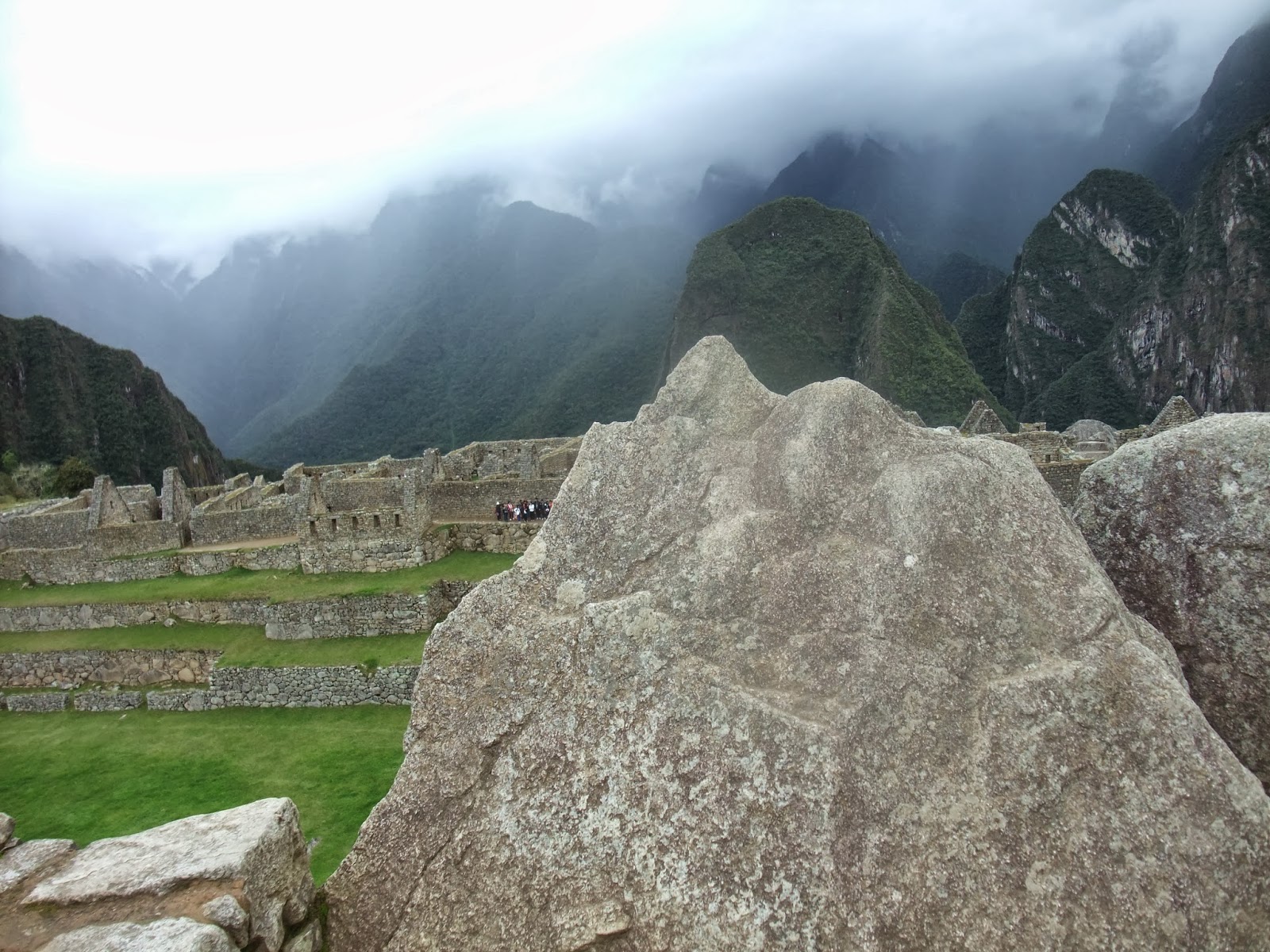
Then they reflected those same mountains in their buildings.  Below is a stone slab that was fashioned to look like those very same mountains (each peak on the stone below is a different mountain - there are lots of layers of mountains around Machu Picchu).  Trust me, if the clouds had cooperated when we took the picture, the likeness between the stone slab and the mountains would have been very striking :-)

The Incas also ensure their living area didn't just have representations of mountains - but it also pointed to the mountains.  Below is a picture of a sun dial.  The based of the sundial is an odd shape with long points - each of which points to a major mountain.


4.  Life in the residential (urban) district....
 
Lest you think the Incas focused solely on crops, mountains and sun gods, they had some pretty neat houses too.  Here's one of them.  It's a two-story wonder - the first floor is living space, complete with the insets in the wall we became so used to seeing, for placing your decorations or Inca gods.  The second story was for storing your crops.  The roof would have been made of thatch.  Not bad for folks living on top of a mountain 500 years ago..... 

 
There were a lot of buildings packed into not a lot of space - here's an idea of the alleyways and stairs in this section:


5. If the Spaniards didn't get to Machu Picchu, what happened to all the Incas?

Remember my first Inca blog mentioned that there were a total of 14 Inca kings, but #9 was the main king.  He made a major expansion of the Inca empire, but he did it by waging war with everyone around - essentially making alot of enemies.

So when the Spaniards came to "Inca Land," they attacked the Incas.  The folks in Machu Picchu left to defend their follow Incas in the lower elevations.  Any remaining non-Incas took advantage of the opportunity to further weaken the remaining population in Machu Picchu, until ultimately, the population at Machu Picchu was no longer sustainable.  And so the area eventually became overgrown with vegetation, waiting to be found in 1950.

The moral of this story is.....

Treat your neighbors right - they may someday treat you the way you treated them!


Friday, October 18, 2013

We May Have Just Met the Father of the Year

When we met Lucero, we also met her father.  He was quite a talkative guy, and by the time he was done talking, we were totally amazed.

For starters, he worked in zinc and silver mines for years, until all the toxins and pollutants in the mines made his health so bad he was forced to stop.  I've visited a couple mines (no longer functioning) in the last few years - enough to appreciate the difficulty and danger of the work, and have tremendous respect for the guys that do that kind of work.  

 Like most folks in Chosica, Peru he could not afford a well-built house, and so be started with a house like the picture below.  This is still part of their house today, but he's been slowly transforming it as he's been able.  Note the piles of cardboard - he collects recyclables that he later sells for money to help support his family.

There is no running water in Chosica, and it only rains 1-2 months per year.  So he built a water tank on top of his house to hold water.  A water truck visits town periodically.  He buys all their water from the water tank, which is then delivered to a tank below his house.  He then pumps the water by hand up to the tank of top of his house to supply "running water."  They have no water besides what he buys and pumps in.
Notice the house walls in the pictures above and below.  As he has been able, he has purchased bricks and has replaced the corrugated siding with the bricks.  He then covered the brick with concrete to make the smooth walls.  This not only looks nicer, but it makes the house more structurally sound to withstand the annual storms and also earthquakes, which are fairly common in this area.  

Below is the bedroom which he constructed for Lucero and her mother 2 years ago. It has a single light bulb hanging from the ceiling - it took him about 10 years before he was able to run electricity into his house.  (Lucero's father still sleeps in lumpy bed in the corner of the main room of the house, near the plastic kitchen table.)
The back of the house runs directly into the side of a mountain.  As you hike up the path of bricks and stones, he has created various small farm areas, so he can provide for his family.  

Below is one of his two chicken coops.
He also grows a few of each type of plants, including spices and corn.  Since it doesn't rain very often in Chosica, he has to water his plants himself - pumping water into buckets, and then carrying them by hand up the mountain.
We couldn't get a picture, but as we walked through the "farm" we suddenly came upon a little old lady sitting in the shade of the plants. This was his 82-year-old aunt, who is in poor health.  She spends her day here sitting in the shade, and Lucero's father cares for her without help from outsiders.  

Below is a sink he built in the house - he was very proud of the pump he installed to provide water from the tank beneath the house to this sink.
Last but certainly not least, go back up to the picture at the top of this post.  This is Lucero's father standing next to a pay phone - his very own pay phone that he had installed in the front of his house as a way to earn more income.  Nobody in this town has a phone, so he called the phone company and asked them to install one in the wall of his house. When neighbors use the phone, he gets a percentage of the call fees.

We were amazed at the ingenuity and hard work we saw in this humble father in Chosica. He is a tremendous example of how hard folks in poverty work to improve the lives of their families with the resources they have available.  On top of what he has done, his work ethic has clearly been transferred to his children.

We were so very impressed with this man, and wanted to share his story!


Thursday, October 17, 2013

Small Church + Missional Vision + Body of Christ = Huge Impact On TheCommunity

Yesterday we visited the church where Lucero attends the Compassion program.  It's on the side of a mountain in a very poor town.  It has only 30-40 attendees.  And yet, the church has a vital ministry to 250 children in the surrounding neighborhood.  We were struck at the size of the ministry this small church was able to have.

I wanted to jot a few notes about how this small church with limited resources was able to have such a big impact on kids and their families.  

1.  Missional vision 

It became apparent that the church has a strong missional focus - they want to reach their community.

2.  Focus on children 

While the church wants to reach people of all ages, they are focusing on reaching children.  Intervention at an early age is more effective than later trying to repair damage done by malnutrition, hardened hearts, poor health, lost educational opportunities, abuse, etc.  They also know that children that become Christ followers also often invite their family and friends to church.

3.  Committed members 

The children's ministry is owned by the members and pastor of this church.  Each person has a role they are responsible for, and they are committed to do that role with excellence.  

Some serve as kitchen workers who cook for hundreds of kids each day.  Some tutor the children after school. Others teach Bible classes.  Some teach the children income generating skills.  Some visit children's homes to understand the issues the child deals with at home, and whether there are any safety/abuse risks.  The list goes on and on....

4.  Drawing on outside expertise

The church did not have the expertise to build this ministry alone.  So they partnered with Compassion International, who provided training, curriculum, connections to medical staff, administrative controls required to ensure the program was well run with integrity, etc.  Compassion all also provides ongoing expert oversight and coaching to ensure the program is effectively achieving the intended goals, and that the children are being faithfully taught the Gospel.

5. Connection to the Body of Christ at-large.

The church clearly lacked the financial resources to do this type of ministry on this scale. Compassion provided connections with sponsors in other countries who help fund the program, and who develop encouraging relationships with the children and share Christ with them through their letters.   This relationship helps reinforce the work of the church workers who minister to the kids and share Christ with them on a daily basis.

With these partnerships, the church was able to put feet to their ministry.  

We learned that Lucero became involved in the local church's Compassion program because a neighbor knew Lucero's family was in great need.  The neighbor brought it to the attention of the church, who initiated a relationship with the family and invited Lucero to join their program.  They explained that as part of the program, Lucero would receive supplemental nutrition, Bible teaching, tutoring in school subjects, etc.  Her parents agreed she should attend.

We asked Lucero's parents how the program has helped.  They said they are not home during the day, and the church has given Lucero a safe place to be during the afternoons. They said it had helped her become more sociable.  And, they are very happy that she is learning about God.  

But that is just Lucero.  There are 250 other children of varying ages just like her, who have a church showing them the love of Christ in a very tangible way, pointing them to faith in Christ, and helping them develop to their full potential. 

All because a small church in a poor town on the side of a mountain had a vision of what God could do, and trusted God to provide help through the rest of the body of Christ.